

Radical thoughts about Church property
Thu July 23 2020 4:26pmFaith/Philosophy
Full-tilt panic over covid-19 has reached Nicaragua, following months of ministerial hand-wringing. To my knowledge, no outright church closings here, but that may be mostly because Ortega has not provided the desired cover of government mandates. Daily Masses discontinued at my parish. The main door barred and locked even during the single Sunday Mass; die-hard parishioners must enter and exit through the small side chapel and through quasi-barriers of shoe and hand disinfectants. Those who come forward for Communion must submit to a second alcohol hand cleansing, with Communion on the tongue disallowed. (Of course, some die-hards still bring their dogs to Mass, without face masks; am not sure if their paws are disinfected. Well, after all, this is Nicaragua.) By the way, no hand cleansing required before putting money into the collection bag.
Together with similar or worse clerical cowardice elsewhere, this has me puzzling anew over the crisis of authority in the Church. When I see my pastor discouraging people from attending Mass, but proceeding apparently uninterrupted with the construction of a large and ugly new auditorium, I think to myself, "Perhaps that's the biggest part of the problem." But more on that below.
Did you know that Canon Law strictly forbids the cancellation of public Masses or barring Catholics from attending? Look it up for yourself. Likewise Canon Law mandates that Catholics in a state of grace be allowed to receive Communion on the tongue. In fact, that's still the prescribed norm, pandemic panic notwithstanding. That is to say, the nervous precautions of pastors and bishops today constitute an out-and-out rebellion against the spirit and letter of Catholic Canon Law. And it gets worse:
Important to distinguish between Canon Law and defined Catholic doctrine. Canon Law may change (slowly) as times change; doctrinal teaching may (even more slowly) develop and deepen in understanding, but must never change. That is, once defined, a Catholic doctrine may not be repealed or nullified. Important as well to recognize when the Law is based upon defined doctrinal teaching, and when it is merely disciplinary or even arbitrary. An example of the former is the all-male priesthood, based upon the doctrinal understanding that the priest is Alter Cristus who must adequately resemble the man (vir) Christ Jesus. Likewise, barring folks from attending Mass is contrary to the Law because contrary to the doctrinal teaching on the central need for the Eucharist, and the very purpose of the priesthood. Bishops and priests who deny the Eucharist to Catholics not only violate Canon Law, but spurn the essence, the raison d'être, of their own priesthood.
By contrast, an example of a merely disciplinary law would be the requirement for priestly celibacy, which is already waived in many cases. Likewise the requirement for several years of formal post-secondary education before ordination. These Canon Law requirements are obviously not doctrinally based. Most of the early priests were neither celibate nor degreed. So these requirements could readily be relaxed or scuttled, much like no meat on Friday or the 3-hour Communion fast.
Speaking of arbitrary rules, I cannot find any doctrinal or Canon Law requirement for the construction of church edifices. As far as I can determine, a Mass said in a private home or outdoors is every bit as valid and licit as a Mass said in a consecrated basilica with a relic in the altar. Please correct me if my understanding is wrong.
Which leads to this point: What would be wrong with recovering the ancient norm of meeting in one another's homes for the 'Breaking of Bread'? And what would be wrong with having the Mass said by the homeowner himself, priest, husband and father? I suppose the main difficulty would be, not doctrine nor Canon Law, but overcoming the long entrenched bureaucratic mindset of a professional priesthood.
This idea is radical. It may also be futuristic. Open your eyes, pastors, and see that, if the increasingly atheistic governments of the world can close your churches because of a virus, they can do so for any other reason as well. So, forget your precious tax-exempt status, which can also be revoked without warning, and which only tames and silences you as docile government serfs. Put aside your real estate holdings and administrative burdens. The government may soon confiscate your church property, so beat them to the punch. Dispose of the land and buildings while you have the freedom to do something worthwhile with the proceeds. Even were this not the future, Catholic bishops would do well, would be truer to their vocation, as poor pilgrims and strangers in a hostile world. The notion of domestic priests and homeless circuit-rider bishops is both ancient and (perhaps) futuristic.
One thing is certain: There would be no church closings if there were no church buildings to close. More importantly, returning to the custom of a literal Domestic Church (just the family, plus perhaps one or two nearby priest-less households) would also return us to a truer sense of the agape feast, of worshipping together with people whom we know and love personally. Plus, since this arrangement would require a fierce loyalty to essential Christian Truth, it could also lead to a greater sense of worldwide Catholic unity, confraternity and fellowship. As we deliberately draw away from friendship with the world and its temporal riches, we draw closer to Christ and towards one another. (cf.James 4:4)
Would any of this be possible? Would it be desirable? How would this idea work, how might it get started, and how fully implemented? Well, even though this is all probably just Jerry's crazy fantasy, an impossible dream, I do hope to develop these thoughts further in subsequent blog posts.
Now that it's more and more difficult to find Sudoku grids that the CyberJerry Sudoku Analyzer (the 'Analyzer') can't analyze step by step, the great Sudoku Challenge is also becoming more difficult. To help out a bit, below are four Sudoku grids that the Analyzer can't analyze step by step. You just have to figure out how to solve one of these analytically (no guesswork) to qualify as a successful Sudoku Challenger. Click on any of the grids to bring it up in the Analyzer. Both it and you should be able to solve several cells. But at some point, the Analyzer gets stuck and can't give a hint. Can your brain keep analyzing beyond that point, and solve the puzzle? If so, click on the corresponding 'Answer Challenge' link and tell me how you did it. As before, I promise to publish your success.
With my brain, I know how to analyze and solve one of the grids below; am not telling which one.(Note 1) But programming the Analyzer to do it would be a bear, and am very unlikely to tackle that job in the near future. Even less likely for the other three, which my brain can't (yet) figure out. So you have lots of time to meet this challenge. Good luck!
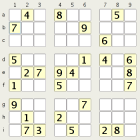
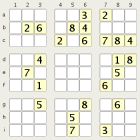
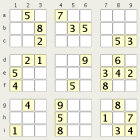
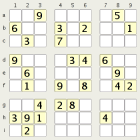
Note 1 (17 July 2020): It was the third one that i could solve with my brain but thought too difficult to program the Analyzer to solve. Surprisingly, after correcting a minor bug, the Analyzer now solves it, in a way that my brain hadn't anticipated. Looks like my brainchild is smarter than my brain. So, anyway, the third one above is now a different Sudoku, one that, like the other three, neither my brain nor the Analyzer can analyze step-by-step.
| 0 comments | rev. Jul 17 2020 7:49pm |
When the Unique Rectangle technique is unavoidable
Fri June 19 2020 9:24pmSudoku
A recent round of minor enhancements and corrections has made the CyberJerry Sudoku Analyzer capable of analyzing increasingly tough Sudokus. Two results: the "New Puzzle" control now offers a "Genius" level, and the "Hint" feature may offer extremely complex hints, containing many interdependent sub-steps of a variety of advanced strategies. The added focus on complex Sudokus has had another unforeseen result: the possibility of encountering what I call the "Unavoidable Avoidable Rectangle". (Not being able to find any mention of the phenomenon in any other website, I claim the right to assign this name to it.) Let me explain: (read article)
| 0 comments | rev. Jun 25 2020 7:40pm |
This blog article serves as both another bug report and as a candidate for the Sudoku Challenge .
This time, the Sudoku Analyzer cannot solve the Sudoku step-by-step. It should be able to. This is a known bug, recently discovered by yours truly, and which yours truly is working on, and hope to have fixed soon.
In the meantime, if you think you can solve this Sudoku analytically (no guesswork), (read article)
| 1 comment | rev. Jun 5 2020 9:45pm |
. . .that through death he might destroy him that had the power of death, that is, the devil. And deliver them who through fear of death were all their lifetime subject to bondage. (Hebrews 2:14b,15)
A blessed Holy Week, and a Joyful Easter to all who read this.
Panic over COVID-19 is growing along curious lines. Those who are closing their shops and offices (and churches) and hiding in their houses or behind surgical masks are generally the rich, the educated, and the elite. At least where I live, most folks who have to work for a living are trying to go about their daily business as usual. Is there (read article)
This Sudoku puzzle has me scratching my head.
The Sudoku Analyzer solves it step by step, giving clues along the way. Which is to say, it is not one of those occasional Sudokus which can only be solved in trial-end-error guesswork manner. But at a couple points, the Sudoku Analyzer gives very complex hints where simple hints are possible. This is not according to design. Then, in at least one very complex hint, several secondary hint steps are omitted, without which the complex hint is incomplete.
What's especially baffling is that these (read article)
| 0 comments | rev. May 22 2020 7:59pm |
It's probably a guy thing, like watching the car's odometer roll over to 100,000 miles. But, when you think about it, observing birthseconds is really no different than celebrating birthdays. Specifically, the occurrence of one's billionth birthsecond is a rather singular milestone in one's life span. It is the only birthsecond magnitude one can observe with any real appreciation. The next lower magnitude, that of 100 million seconds, occurs when one is just a tad over 3 years old, too young to grasp what such a number entails. The next larger magnitude, 10 billion seconds, occurs at an interval of over 300 years; no chance to observe that event.
Just shy of 32 years of (read article)
| 1 comment | rev. May 6 2020 11:50am |
